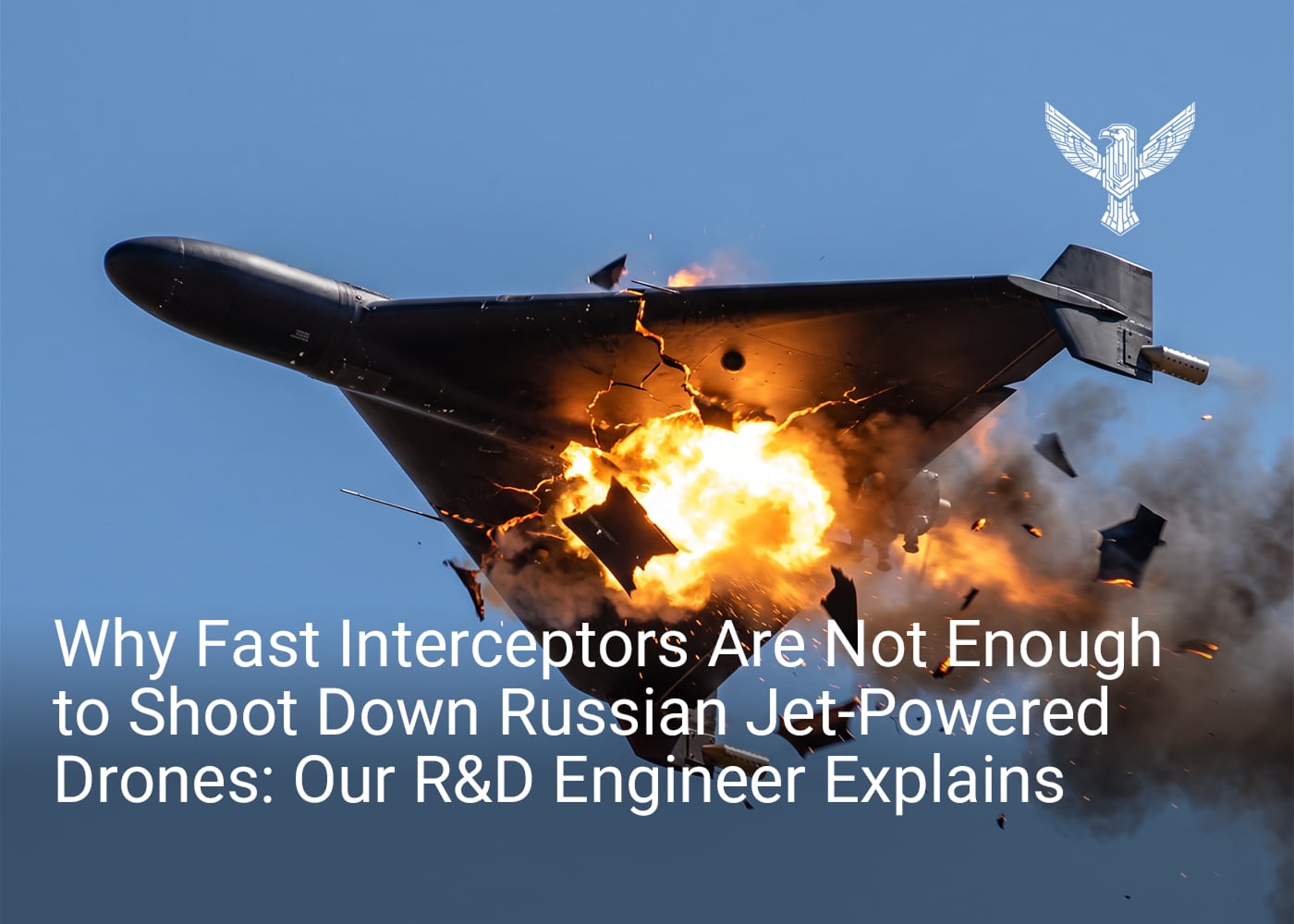
Russian jet-powered drones pose a new level of complexity for Ukraine’s air defence. Even the emergence of faster interceptor drones will not solve the problem automatically. To counter these new threats effectively, operators must detect the target in time, prepare the interceptor for launch, and successfully engage the jet-powered UAV. There are only a few minutes to complete the entire process.
Danylo, Chief R&D Engineer at BlueBird Tech, explains the details.
According to the engineer, detecting a jet-powered target remains one of the key challenges. This requires a sufficient number of detection systems—primarily radars capable not only of detecting an object but also of tracking it. The necessary technological capabilities already exist; however, the main issue is the number of available systems and the density of their deployment.
Guidance is the second important factor. Many previous generations of interceptor drone systems rely on visual contact with the target. Cloud cover, fog, smoke, and other conditions that limit visibility can make interception significantly more difficult.
Weather conditions create another challenge. Jet-powered platforms have greater thrust reserves and can continue flying in more demanding weather conditions. Strong winds, however, can become a critical factor for a conventional interceptor drone, as it may simply lack the power required to reach the necessary interception trajectory.
“Having a jet-powered interceptor does not mean the problem has been solved. If the difference between the speeds of the target and the interceptor is only several dozen kilometres per hour, a fundamental physical limitation arises: the interceptor may simply be unable to close the distance in time. This is why detection time, the closing trajectory, and the ability to bring the interceptor rapidly into the required operating mode are critical for such systems,” explains Danylo, Chief R&D Engineer at BlueBird Tech.
The situation can be compared to two cars: if the target is travelling at 100 km/h and the interceptor can reach 110 km/h, the interceptor will gradually close the distance, but this takes time. If the drone is already approaching its intended target, there may not be enough time remaining.
One promising approach is therefore to intercept the target from the side or on a head-on course rather than pursuing it from behind. However, this method requires the target to be detected sufficiently early.