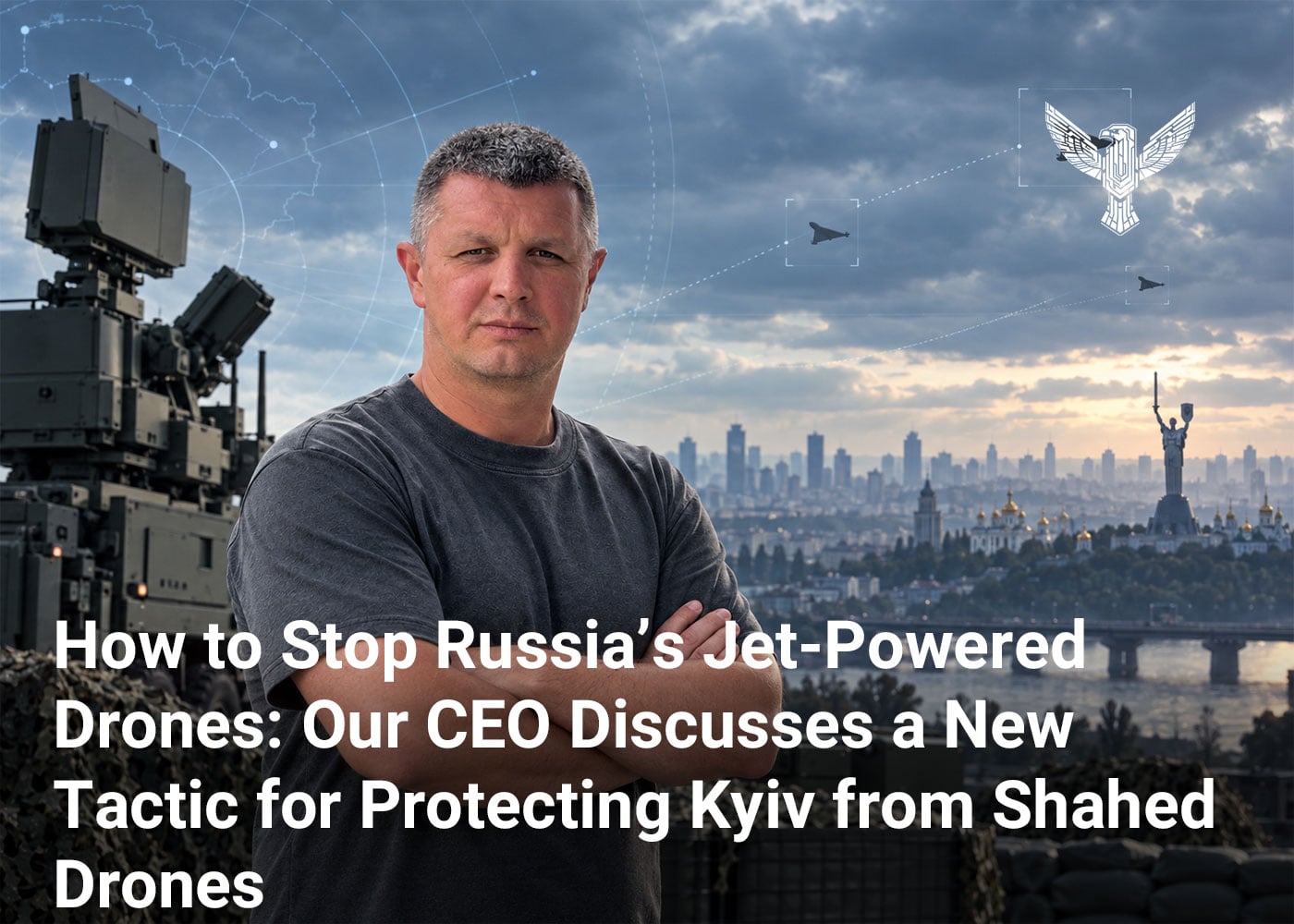
Russia is scaling up production and increasing its use of jet-powered attack drones against Ukraine. For comparison, Ukraine recorded around 180 instances of such drones being used throughout 2025, while approximately 2,800 were recorded in August 2026 alone. Jet-powered drones are now attacking Ukraine almost around the clock.
BlueBird Tech CEO Valerii Zarubin discusses this issue in his column.
The expert emphasises that jet-powered drones are no longer an experimental weapon for Russia. Their increasing deployment indicates a change in Russia’s approach to aerial attacks against Ukraine.
The interception rate for jet-powered targets currently stands at around 60%, compared with 90–95% for conventional Shahed drones. The reason is clear: jet-powered drones are significantly faster than conventional Shahed drones, leaving Ukraine less time to detect, identify, and intercept them. As a result, traditional air defence systems are becoming less effective, while the role of aviation, surface-to-air missile systems, and interceptor drones is growing.
“This is an attempt to intimidate Ukrainians, overwhelm the air defence system, and destroy more civilian infrastructure at the same time. The enemy sees that this technology is currently more effective and will therefore try to scale up attacks using jet-powered systems,” said Valerii Zarubin, CEO of BlueBird Tech.
What Ukraine Needs to Counter Jet-Powered Drones Effectively
According to Valerii Zarubin, one of Ukraine’s main challenges is not only interception effectiveness but also its cost. If the enemy uses a relatively inexpensive munition while Ukraine responds with a much more expensive air defence system, even a successful interception does not solve the problem at the strategic level — because Ukraine will be losing economically.
Ukraine needs to scale up cost-effective countermeasures, particularly interceptor drones, develop domestic production of jet engines, increase the number of radars, and simultaneously target the production and logistics infrastructure supporting Russian UAVs.
Another area that already requires Ukraine’s attention is the autonomy of military systems and the use of artificial intelligence. In the future, unmanned systems will be able to analyse their surroundings, adjust their routes, and make some decisions independently without continuous operator control.
Similar technologies will also be developed for counter-UAS systems, ranging from airspace analysis to automated signal detection and target allocation.
“Our task is not simply to catch up with every new threat, but to build a system capable of adapting faster than the enemy and staying ahead of it,” added Valerii Zarubin, CEO of BlueBird Tech.
Electronic warfare systems will continue to play a distinct role. BlueBird Tech develops electronic warfare solutions and improves its Hrets systems in close cooperation with the military.
Zarubin explains that once Ukraine learns to counter current systems effectively, the enemy will look for its next technological advantage: cheaper weapons, a greater number of targets, new tactics, or a higher level of autonomy. A technologically advanced Ukraine must be prepared for this.