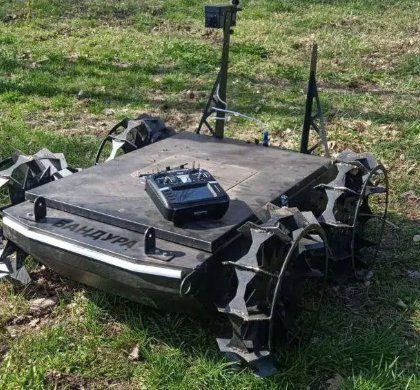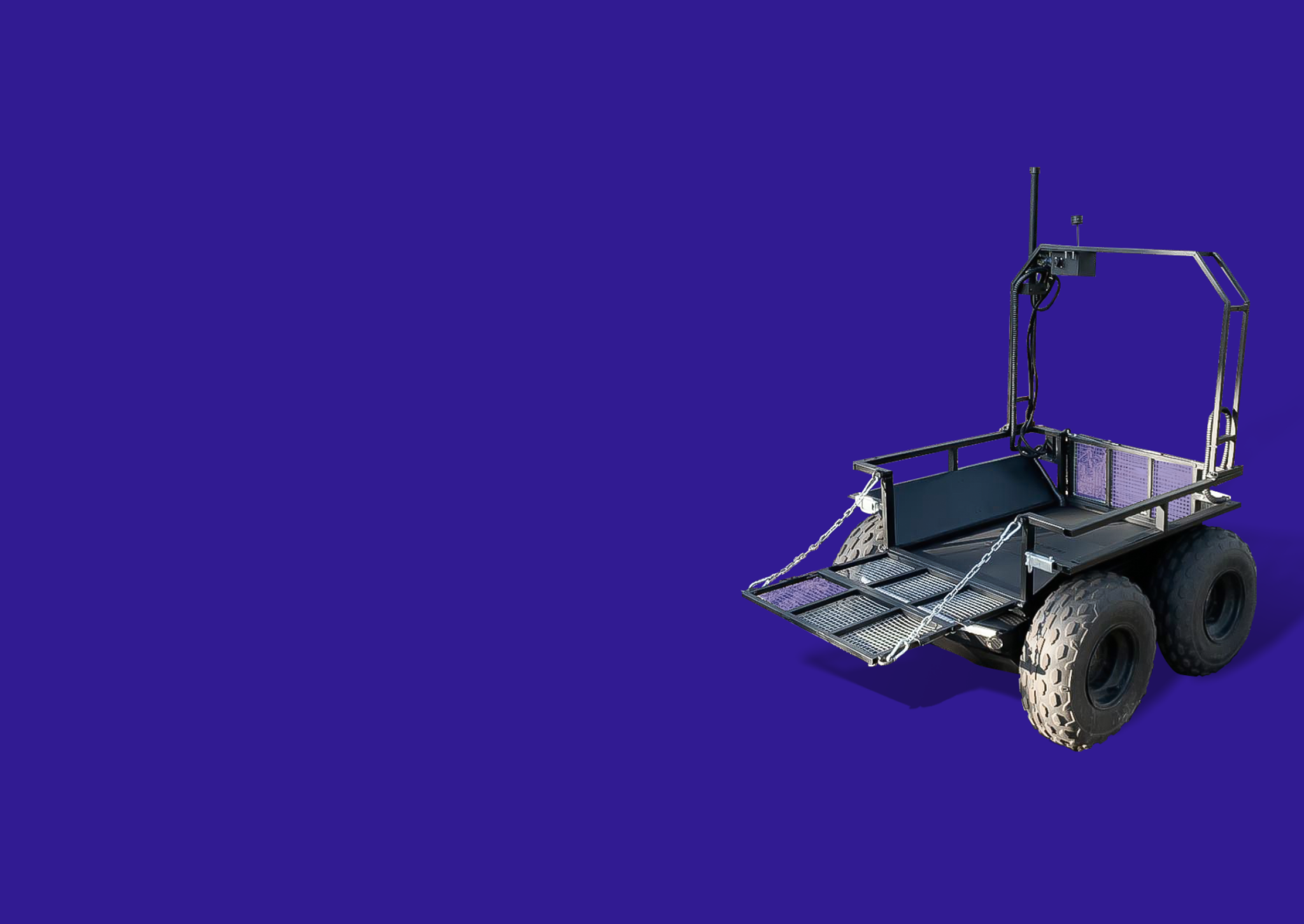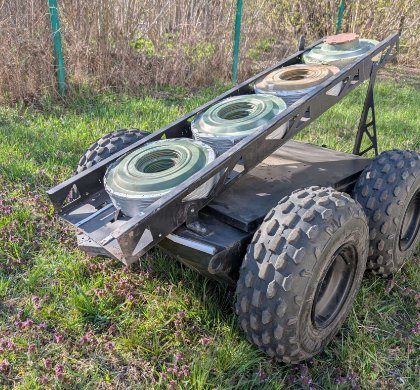
“Bandura” UGV miner
- Maximum speed: 8 km/h
- Operational range: 4–5 km
- Travel distance: 25.6 km
- Payload capacity: up to 150 kg
- Platform weight: 160 kg
An unmanned ground vehicle (UGV) is a modular unmanned ground platform with four independent drive wheels, designed for logistics, evacuation, mining, and reconnaissance tasks under remote control.
Unmanned ground platforms for performing logistics, engineering, and tactical tasks in complex conditions.
The choice of a UGV depends on the type of tasks, required payload capacity, control range, autonomy, and operating conditions.
In high-risk zones, it is important to minimize personnel risk. Unmanned ground vehicles allow you to:
The ground robot is remotely controlled by an operator via a radio link, transmits real-time video from its camera, and performs movement or specialized tasks, enabling operations at a distance without involving personnel.
Not sure which model or accessories are right for your specific task?
Contact us – we will help you choose the optimal solution and explain the technical details in simple terms. Phone: +38 073 864 04 07 For safety, please use only the official communication channels listed on the website.
An unmanned ground vehicle (UGV) is a remotely controlled platform that operates like a large off-road remote-controlled vehicle. The operator controls the system remotely via a communication link and receives real-time video from an onboard camera. Such platforms are used for cargo transportation, casualty evacuation, engineering tasks, and operations in hazardous areas without direct personnel presence.
The “Bandura” UGV supports a payload capacity of up to 200 kg on hard surfaces, while the “Bandura” UGV Miner modification can carry up to 150 kg. These specifications make the platform suitable for transporting equipment, supplies, and performing engineering tasks. Actual performance depends on terrain type, surface conditions, and proper load distribution.
The “Bandura” unmanned ground vehicle (UGV) has a tactical operating range of approximately 4–5 km under stable signal conditions. The ELRS system is used for remote control, providing transmission of commands and video feed in field conditions. System stability depends on terrain, weather conditions, and the presence of obstacles.
The “Bandura” UGV can cover over 25 km continuously on a single battery charge. During testing, the platform traveled 25.6 km off-road with partial battery discharge. The actual range depends on payload weight, terrain type, driving speed, and weather conditions.
Yes, the “Bandura” unmanned ground vehicle supports the evacuation of one person in a lying position. Its platform design and payload capacity allow it to be used for transporting injured personnel in challenging field conditions. The effectiveness of evacuation depends on terrain, weather conditions, and proper platform configuration.
The “Bandura” UGV can move across sand, mud, grass, and puddles, and can also overcome logs up to 300 mm in diameter. The platform is capable of handling slopes of up to 25–30° and operating on complex terrain. Its high mobility is ensured by four independent drive wheels and a low center of gravity.
The “Bandura” UGV supports remote control via the ELRS system, which allows it to maintain operability in challenging communication environments. Its effectiveness depends on the intensity of electronic warfare interference, equipment configuration, and terrain conditions. For stable operation, proper system setup and appropriate signal relay usage are recommended.
The main difference between the models lies in their specialization and payload capacity. The “Bandura” UGV is designed for logistics, evacuation, and engineering tasks and supports a payload of up to 200 kg. The “Bandura” UGV Miner is developed for remote mining and engineering operations and has a payload capacity of up to 150 kg, while maintaining similar operating range and mobility characteristics.
Yes, unmanned ground vehicles are actively used to transport ammunition, equipment, generators, water, and other supplies. With a payload capacity of up to 200 kg, the “Bandura” UGV helps reduce risks to personnel during logistics operations. Delivery efficiency depends on terrain conditions and the weight of the cargo.
Yes, the “Bandura” UGV is equipped with an analog night camera for remote control in low-light conditions. Real-time video transmission allows the operator to control the platform regardless of the time of day. The quality of visibility depends on weather conditions and terrain features.
An unmanned ground vehicle is remotely controlled by a single operator via the ELRS communication system. The operator receives real-time video from the onboard camera and controls the platform’s movement at distances of up to 4–5 km. This operating principle enables missions to be carried out in hazardous areas without direct personnel presence.
The “Bandura” and “Bandura Miner” unmanned ground vehicles can be purchased through BlueBird Tech‘s official channels. The catalog includes models designed for logistics, evacuation, and engineering tasks, each with distinct purposes and payload capacities. When selecting a unit, it is important to consider the mission type, operating conditions, and required payload.
The Bandura ground robotic complex is a simple, proven ground platform based on 4 drive wheels, designed to perform reconnaissance, engineering or demonstration tasks.